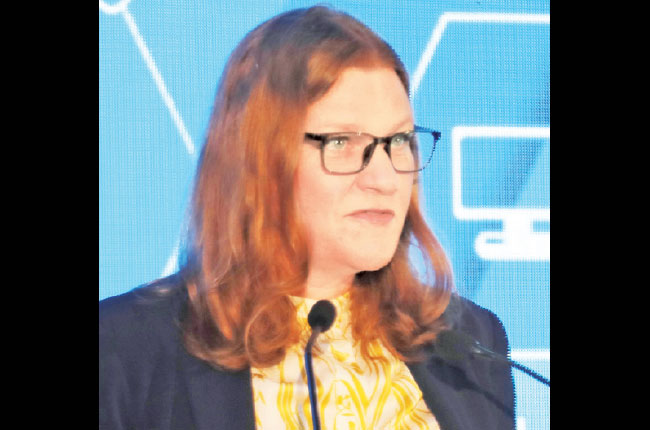
The Sri Lanka economy must continue to grow at a pace that generates employment opportunities for women. This requires mobilising investments in sectors with high growth potential and stimulating economic development in historically disadvantaged and lagging regions, opined Shannon Cowlin, Country Director for Sri Lanka, ADB addressing the Serendipity Knowledge Program (SKOP), Unlocking Women’s Economic Potential in Sri Lanka: Barriers and Policy Pathways held in Colombo yesterday.
She said ADB’s country partnership strategy for Sri Lanka 2024 to 2028 notes that Sri Lanka’s economic recovery offers an opportunity to advance gender equality and social inclusion by addressing deep-rooted structural barriers that impede progress and support policies and programmes that increase women’s access to education, skills, training, finance, employment opportunities, entrepreneurship, social protection and infrastructure. ADB through its projects and programmes aims for more transformative change to address emerging challenges of gender equality and women’s empowerment.
Cowlin said, “While a lot of progress has been made in addressing gender equality challenges, Sri Lanka still ranks at number 130 out of 148 countries in terms of gender equality, according to the World Economic Forum.Women’s economic participation is one notable challenge. Numerous studies have been conducted to understand the reasons for low female labour force participation and the factors shaping it are complex, layered, intersectional and multi-dimensional. ADB recently contributed to the body of knowledge in this area through a study which was initiated at the request of the National Planning Department of Sri Lanka and published at the end of last year.”
She said the event was anchored in the findings of that report which highlights many barriers that still prevent women from fully participating in the workforce and contributing equally to the country’s economic development. These findings include that many women remain concentrated in informal, low-paid and insecure forms of work with limited social protection and few pathways for upward mobility. That social and cultural roles and expectations often assign women to primary caregiving and household duties limiting career opportunities.
Cowlin said the lack of affordable and accessible child care makes it difficult for many mothers to work full-time or to combine income generation with other responsibilities. That unequal access to digital skills, technology and information often creates new forms of exclusion for women, particularly those in rural and disadvantaged communities. That lack of safe workplaces and harassment reduce women’s retention and career progression and that safety concerns and limited transport options discourage women from travelling from work especially during late hours and in rural areas.
Empowering women to participate fully in the labour force is not only a matter of equality, rather it is essential for inclusive economic growth and lowering poverty in Sri Lanka. Ultimately improving women’s labour force participation requires more than isolated policy interventions, she added.
Source: Daily News