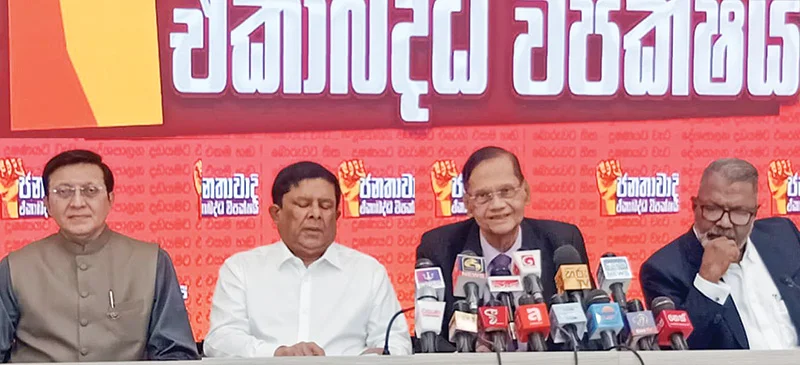
The government claimed that billions of rupees had been allocated for capital expenditure in this year’s Budget, but there was no practical programme in place to ensure that these funds are put to use at the grassroots level to provide relief to the people, owing to existing legal and administrative obstacles, Prof. G. L. Peiris said yesterday, addressing a People’s United Opposition media briefing, at Flower Road, Colombo.
Prof. Peiris said government executive officers were extremely reluctant to spend public funds through the tendering process. Subsequent investigations and new laws, such as the proposed Protection of the State from Terrorism Act, had exposed even officials who make decisions in good faith to the risk of punishment under criminal law. As a result, officials were reluctant to assume responsibility, bringing development projects to a complete standstill.
Although Rs. 500 billion was allocated for people affected by Cyclone Ditwah, only a very small proportion, around 8%, had been spent, Prof. Peiris said, adding that of the Rs. 1,380 billion allocated for capital expenditure last year, only about 18% had been spent by the middle of the year. Even by the end of the year, the maximum that could be spent would be between 30% and 40%.
Although Rs. 2,000 billion had been allocated in this year’s Budget, the government had not presented any report on how the previous year’s allocation was utilised, Prof. Peiris noted.
Prof. Peiris argued that inflation, which stood at a near-zero level of 0.8% when the present government came to power, had now risen to 8.3%. Similarly, the value of the US dollar, which had been brought down to Rs. 293 during Ranil Wickremesinghe’s administration, had now increased to Rs. 337.
The government’s claim that the depreciation of the rupee was due to the war in the Middle East is entirely baseless. The US dollar had already risen to Rs. 325 even before the war began on February 28, 2026, said Prof. Peiris.
Making a comparison between the second quarter of last year and the corresponding quarter this year, Prof. Peiris said Sri Lanka’s economic growth had contracted significantly, from 5.1% to 4.2%. The loss of a stable and conducive environment necessary to retain foreign investment in the country had been the main reason for this economic slowdown. The suspension by the present government of the Economic Transformation Act, enacted by the previous administration, had halted the growth of foreign reserves. During the 28 months of Ranil Wickremesinghe’s administration, reserves had increased by US$6 billion, whereas during the present government’s 28 months in office, the increase has been only around US$1 billion. Consequently, not only are new investments failing to come into the country, but existing investors are also leaving:
“In particular, the country has lost Adani Group’s US$500 million energy investment. A US$392 million project that China Merchants Group was to undertake has been discontinued. Nexus, a company in the apparel sector that had operated in Sri Lanka for a long time, has decided to leave the country, putting 2,000 jobs at risk,” Prof. Peiris said.
Furthermore, investments were increasingly flowing to other countries, such as Bangladesh and Vietnam, because Sri Lanka lacked a conducive environment for foreign investment, Prof. Peiris noted, adding that the departure of major multinational companies and global brands is placing the economy at further risk. “According to World Bank reports, 30% of Sri Lanka’s population lives in poverty, while six million people are unable to afford even one nutritious meal a day. Doctors, engineers, teachers, university academics and other trade unions have taken to the streets, having lost confidence in the government because it has failed to honour its promises.”
As a result, the entire trade union sector was now dissatisfied with the government. With their expectations unmet and the promises made to them unfulfilled, those groups were preparing to resume their struggles against the government’s actions, Prof. Peiris warned. “Economic growth is essential if Sri Lanka is to resume repayment of its foreign debt in 2027. Foreign investment must flow into the country if it is to secure the necessary financing. Unfortunately, the present government has failed to attract any major foreign investment to Sri Lanka. I wish to emphasise that this failure is exposing the country to a serious economic predicament.”
The Island